A plate-bearing test rig on a Dunedin site tells an immediate story. The jack extends, the dial gauges register millimetre settlement, and within half an hour you have a load-deformation curve that reflects decades of local geology. Shallow foundation design here means reading that curve against tuff-derived silts in Mornington, compressible alluvium in South Dunedin, and schist bedrock rising toward the Town Belt. The team brings a 50-tonne capacity kit with calibrated load cells and LVDT displacement transducers, setting up directly on the bearing stratum to capture in-situ modulus and ultimate capacity. For sites where access restricts larger equipment, test pits let the geologist log the bearing layer by hand—examining moisture content, consistency, and any paleosol horizons that laboratory classification alone would miss. The data feeds directly into bearing pressure recommendations that account for the 1-in-500-year seismic demand prescribed by NZS 1170.5, because Dunedin sits within a moderate seismicity zone where foundation performance under cyclic loading is not optional.
Bearing capacity in Dunedin is rarely about the soil alone; it is about how the soil and groundwater respond together during the hundred-year earthquake.
Methodology applied in Dunedin
Live process video
Local geotechnical conditions in Dunedin
South Dunedin presents a textbook case of what happens when shallow foundations meet high groundwater and loose saturated sands. The area is built on reclaimed harbour sediment, and the water table often sits within a metre of the surface. Cyclic liquefaction—not just bearing failure—becomes the design driver. The simplified procedure after Boulanger and Idriss uses CPT-derived normalised tip resistance to estimate the factor of safety against triggering at depths up to six metres, with post-liquefaction settlement calculated from Tokimatsu and Seed volumetric strain correlations. A shallow foundation in this zone without ground improvement may undergo 50 to 80 millimetres of differential settlement during a design-level event, which tears apart slab-on-grade floors and ruptures buried services. The design response includes densification via vibrocompaction or replacement with compacted engineered fill to a depth below the liquefiable layer. On hill slopes underlain by Port Chalmers Breccia, the risk shifts to sliding along relict joint surfaces, so slope stability assessment must accompany any footing design within 15 metres of a crest or toe.
Our services
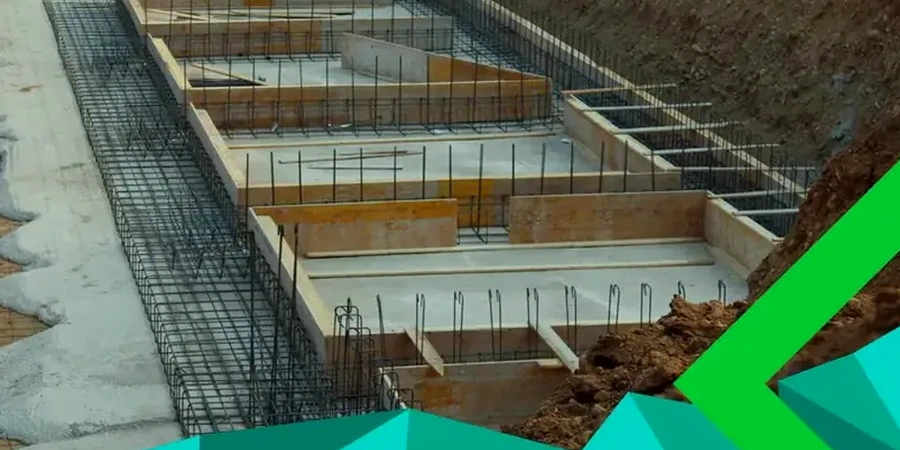
Every shallow foundation design package includes site-specific recommendations that the contractor can read directly from the drawings. No generic bearing pressures. No assumed soil profiles.
Bearing capacity and settlement analysis
Site investigation data from SPT, CPT, or test pits is interpreted to produce allowable bearing pressures for strip, pad, and raft footings. Settlement is calculated in both the short and long term, with consolidation rates estimated where clay thickness exceeds the footing influence zone.
Foundation condition assessment for existing structures
Crack mapping, level surveys, and selective subsurface investigation diagnose the cause of footing movement. The output is a remediation scope—underpinning, grout injection, or drainage improvement—prioritised by structural risk.
Common questions
What does a shallow foundation design report cost for a standard Dunedin residential section?
For a single-dwelling site with access for a truck-mounted drill rig, the combined investigation and design report typically ranges from NZ$2,740 to NZ$5,320. The spread reflects the number of boreholes or CPT soundings required and whether laboratory testing—triaxial, consolidation, or Atterberg limits—is needed to characterise the bearing stratum.
How deep do footings need to be in Dunedin's hill suburbs?
Depth is governed by the soil type and slope geometry, not a blanket number. In loess-derived silts common around Roslyn and Maori Hill, 450 millimetres below finished ground is the minimum to get below the zone of seasonal moisture fluctuation. Where the ground slopes steeper than 1:4, the embedment on the downslope side increases to maintain a minimum 1.5-metre horizontal setback from the slope face, per NZS 3604 Table 7.1.
Can you design a shallow foundation where the water table is high?
Yes, but the design approach changes. In areas like South Dunedin where groundwater is within a metre of the surface, the bearing capacity calculation uses buoyant unit weights below the water table, and the settlement analysis accounts for the reduced effective stress. If liquefaction is a risk, the report quantifies expected settlement and recommends ground improvement—typically stone columns or vibrocompaction—to bring performance within acceptable limits.