NZS 3404 and the NZGS guidelines frame every soil mechanics study we deliver across Dunedin. The city sits on a complex mosaic of basalt flows, loess deposits, and alluvial silts — a stratigraphy that demands more than textbook assumptions. On the Taieri Plain, compressible organic silts extend well below the water table, while the hills surrounding the Otago Harbour expose residual clays weathered from schist and volcanic rock. A test pits investigation is often the first step to log these shallow units, identifying fill thickness and groundwater depth before sampling begins. Where deeper profiling is required, we combine borehole sampling with CPT testing to capture continuous cone resistance and pore pressure data through the layered sequence — a practical approach when the difference between dredged harbour fill and natural alluvium can be less than a metre.
Dunedin basalt residual soils can exhibit cohesion values above 50 kPa at low strain but lose strength rapidly after peak — a behaviour that laboratory testing must capture for safe foundation design.
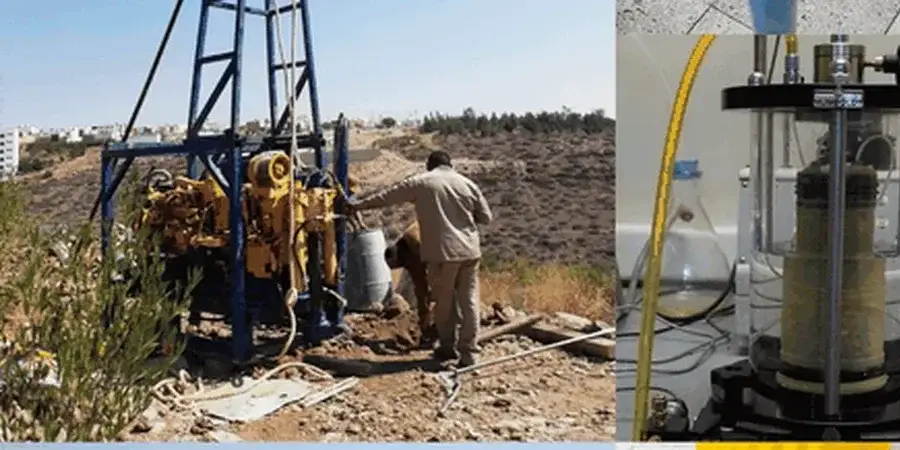
Methodology applied in Dunedin
Live process video
Local geotechnical conditions in Dunedin
The Abbotsford landslide of 1979 remains a defining event for geotechnical practice in Dunedin. Failure occurred along a weak clay layer within the Caversham Formation after prolonged rainfall, destroying 69 houses and reshaping the regulatory approach to slope development across the city. That geological reality — weak, moisture-sensitive sediments overlying more competent rock — repeats across many Dunedin hillside subdivisions. A soil mechanics study that omits residual strength testing on these materials misses the controlling parameter for long-term slope stability. On the flat, the hazard shifts to liquefaction: the reclaimed and alluvial soils of South Dunedin sit above a shallow water table in a moderate seismicity zone, and the NZGS Module 4 framework now requires quantitative assessment using SPT or CPT data to evaluate cyclic resistance. Neither problem can be resolved by precedent alone — each site needs its own measured parameters because the facies change within tens of metres across the city.
Our services
A soil mechanics study in Dunedin must address two distinct geotechnical domains — the volcanic and loess-mantled hills, and the compressible alluvial flats. Our laboratory programme is configured to produce the design parameters each domain requires, from effective stress strength for slope analysis to consolidation and permeability data for settlement prediction.
Index testing and soil classification
Atterberg limits, particle size distribution by sieve and hydrometer, and moisture content determination on samples from hand-auger boreholes, test pits, or rotary core. Classification to NZGS field description guidelines provides the framework for parameter selection.
Consolidation and settlement analysis
One-dimensional consolidation testing (oedometer) on undisturbed specimens from the Taieri alluvium and South Dunedin compressible silts. We report Cc, Cr, cv, and preconsolidation pressure for use in settlement calculations under footing and embankment loads.
Triaxial strength testing
Consolidated-undrained (CU) and unconsolidated-undrained (UU) triaxial tests on residual clays, loess-derived silts, and alluvial materials. Pore pressure measurement during shear yields effective stress parameters c' and φ' for stability analysis and retaining wall design.
Permeability and compaction testing
Falling-head and constant-head laboratory permeability on fine-grained soils, plus standard and modified Proctor compaction tests for engineered fill specification. Relevant to drainage design and earthworks QA on Dunedin subdivision projects.
Common questions
What does a soil mechanics study cost for a residential section in Dunedin?
A typical residential soil mechanics study in Dunedin — including site investigation, laboratory index testing, and a geotechnical report — ranges from NZ$5,830 to NZ$9,240 depending on the number of boreholes or test pits, the depth of sampling, and the complexity of laboratory testing required. Sites with known hazards such as loess instability or high groundwater may need additional triaxial or consolidation testing, which extends the scope and cost. We provide a fixed-price proposal after reviewing the site location and development plans.
How do Dunedin loess soils affect foundation design?
Dunedin loess is a wind-deposited silt that can stand vertically when dry but collapses rapidly when saturated. Its metastable structure means foundations must either bypass the loess to bear on competent material below, or be designed for the settlement that occurs if the loess becomes wet during the life of the structure. Laboratory testing measures collapse potential and shear strength at natural and saturated moisture contents so the structural engineer has parameters for both drained and undrained conditions.
Is liquefaction assessment part of a standard soil mechanics study in Dunedin?
Not automatically — liquefaction assessment is triggered by site location and soil type. If the property sits on alluvial or reclaimed soils in South Dunedin, or on saturated sands elsewhere, the NZGS Module 4 framework applies. In those cases, we include SPT or CPT field testing and laboratory grain-size analysis to evaluate liquefaction susceptibility. Sites on volcanic rock or dense residual soils above the water table generally do not require this assessment.
What laboratory tests are essential for a subdivision earthworks specification?
For subdivision earthworks in Dunedin, the essential laboratory suite includes Atterberg limits and particle size distribution to classify fill materials, standard or modified Proctor compaction testing to establish maximum dry density and optimum moisture content, and permeability testing if drainage layers are specified. If cuts expose loess or Caversham Formation clays, we recommend triaxial testing to confirm the design strength parameters assumed in the slope stability analysis.