We still see engineers approving cut slopes in Dunedin’s loess without proper stability modeling. The material stands near-vertical in a test pit. Then a wet winter hits and the whole face slumps onto the road. That failure mode is well documented across the Otago Peninsula and it is entirely avoidable with the right analysis. Our team runs limit equilibrium and finite element models calibrated to local stratigraphy—basalt over Tertiary sediments, jointed schist in the Town Belt, colluvium on the southern flanks. This is not generic software output. It is geotechnical analysis built around NZGS soil parameters and real pore-water pressure data collected on site. When the council asks for a seismic microzonation input or a liquefaction screening trigger, we can integrate that into the slope model without redoing the whole investigation.
Factor of safety means nothing if the failure mechanism you modelled is not the one the geology gives you.
Methodology applied in Dunedin
Live process video
Local geotechnical conditions in Dunedin
NZS 3404 and the NZGS slope stability guidelines set clear acceptance criteria for residential and infrastructure earthworks. Dunedin City Council’s District Plan also triggers geotechnical assessment for any excavation deeper than 1.5 metres on slopes steeper than 15 degrees, which covers most of the hill suburbs from Maori Hill to St. Clair. The risk here is not just global instability. Loess collapse on wetting, progressive failure along relict shear surfaces in the Abbotsford Formation, and toppling failure in columnar basalt are all failure modes we have observed across the city. A desktop study or a walkover alone will miss these. An analysis that respects local geomorphology—the buried paleochannels under Kaikorai Valley, the landslide terrain mapped by GNS Science—is the difference between a consented design and a costly remediation job two years later.
Our services
Slope stability work in Dunedin typically requires two levels of output depending on the project stage. We deliver both.
Feasibility & Land Development Slope Assessment
Desktop review, geological mapping, and limit equilibrium modelling for resource consent applications. We provide FoS calculations for the building platform, accessway batters, and any downslope risk to neighbouring properties. Outputs formatted for DCC engineering review.
Detailed Design & Remediation Analysis
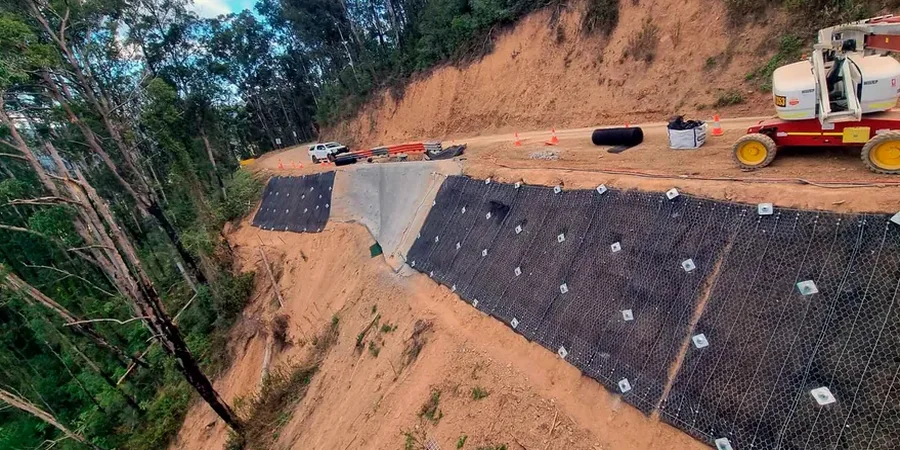
Full ground investigation, instrumentation (inclinometers, piezometers), and FEM modelling for cut and fill design. We specify soil nail patterns, anchor loads, drainage arrays, and bench geometries. Construction-phase monitoring and back-analysis included.
Common questions
What is the typical cost range for a slope stability analysis in Dunedin?
For a standard residential subdivision lot or single retaining wall, slope stability analysis in Dunedin typically costs between NZ$1,980 and NZ$6,550. The final fee depends on the size of the failure mechanism being assessed, whether drilling and laboratory testing are required, and the complexity of the geology. A simple infinite slope model with published parameters sits at the lower end. A full 2D FEM with site-specific triaxial data and pore-water pressure calibration runs higher. We provide a fixed-fee proposal after a site walkover.
Do I need a slope stability analysis for a retaining wall consent in Dunedin?
Dunedin City Council will almost always request a slope stability assessment if your wall retains more than 1.5 metres of ground or if the wall is on a slope greater than 15 degrees. The NZGS guidelines also require global stability checks for any gravity or cantilever wall. We prepare the analysis as a standalone report or integrate it into the retaining wall design package for efficient consent processing.
How long does a slope stability assessment take from investigation to report?
A desktop-level analysis with published parameters can be turned around in 5 to 7 working days. If site investigation is required—boreholes, test pitting, sampling, and triaxial testing—allow 4 to 6 weeks from drilling to final report delivery. We coordinate the drilling crew, the laboratory, and the council pre-app meetings so the timeline is predictable.