Too many projects in Dunedin still rely on fixed-base assumptions that ignore how the local geology amplifies ground motion. The result is a structural design that looks compliant on paper but transfers excessive seismic force into the building frame during a moderate Alpine Fault event. Base isolation changes that equation entirely—it decouples the superstructure from the ground, cutting spectral acceleration demands by 40 to 60 percent depending on isolator type and site period. For hillside sites on Caversham sandstone or Leith Valley alluvium, the isolation plane must be designed alongside the foundation system so differential settlement does not compromise the gap clearance. We combine site-specific seismic microzonation with nonlinear time-history analysis to size lead-rubber bearings or friction pendulum systems that stay functional after the maximum considered earthquake. That approach turns a code-minimum building into one that can be reoccupied within days instead of months.
A properly tuned isolation system in Dunedin can reduce peak floor accelerations by more than half, protecting both structural elements and the contents that represent the bulk of the building's insured value.
Methodology applied in Dunedin
Local geotechnical conditions in Dunedin
A 14-storey residential tower on the one-way street grid near the Octagon was conceived with a fixed-base lateral system—until the geotechnical investigation revealed a buried paleochannel filled with compressible silts. The structural engineer's initial model showed interstory drifts exceeding 2.5 percent under the 1-in-500-year event, well beyond the NZS 1170.5 limit. Retrofitting the design with a base isolation plane dropped those drifts below 0.8 percent and eliminated the need for heavily reinforced shear walls that would have compromised the ground-floor retail layout. The cost shift was not trivial—the isolators and moat added roughly 6 percent to the structural budget—but the developer recovered that through faster consenting and a 15 percent reduction in the earthquake insurance premium. The lesson is that Dunedin's variable geology can make isolation the economical choice, not just the performance choice, once total project cost is tallied.
Our services
Our base isolation work in Dunedin covers the full design chain—from site characterisation and isolator selection through to prototype testing oversight and peer review for consenting.
Isolation system design & modelling
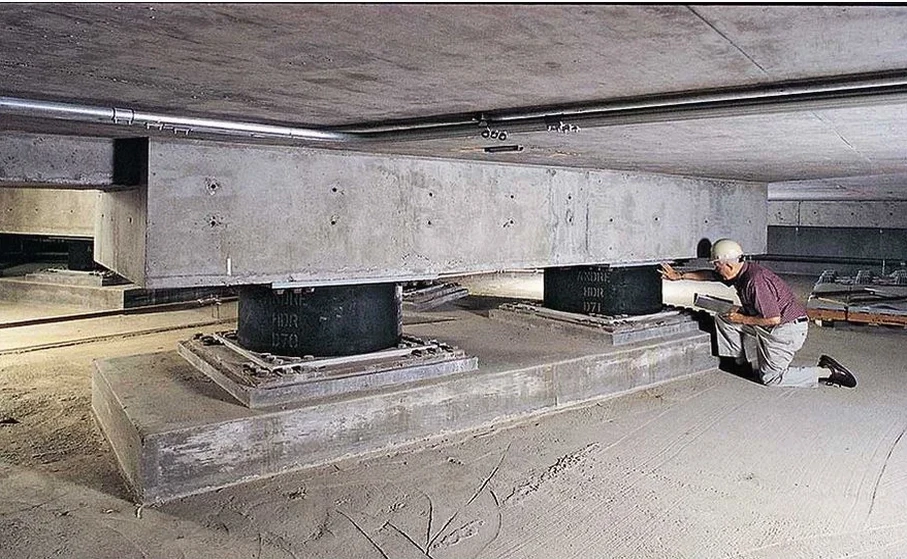
Nonlinear time-history analysis with lead-rubber or friction pendulum bearings, matched to site-specific spectra derived from probabilistic seismic hazard assessment. Includes moat wall detailing, service penetrations across the isolation plane, and uplift restraint where tension demands appear.
Prototype testing & construction phase support
We specify the test protocol per ISO 22762, witness full-scale bearing tests at the manufacturer's facility, and review the hysteresis loops against design properties. During installation we verify pad flatness, bolt torque, and final isolator alignment before the superstructure is cast.
Common questions
What is the approximate cost range for base isolation design on a typical Dunedin commercial building?
For a mid-rise commercial project the design and peer review fees for the isolation system typically fall between NZ$6,030 and NZ$14,080, depending on the number of isolators, the complexity of the time-history analysis, and the prototype testing scope. This covers the structural engineering of the isolation plane and moat but excludes the manufacture and supply of the bearings themselves.
Does Dunedin's geology favour lead-rubber bearings or friction pendulum systems?
Both systems perform well here, but the choice depends on the site period. Friction pendulums offer a longer effective period with a smaller plan footprint, which is useful on the soft alluvial sites common near the harbour. Lead-rubber bearings provide inherent damping and recentering force that suits stiffer basalt sites where displacement control is the priority.
How do you verify that the isolators will perform as designed during an earthquake?
Every bearing type undergoes full-scale prototype testing at an ISO 17025-accredited laboratory. The test protocol applies three fully reversed cycles at the maximum considered earthquake displacement, plus additional cycles at wind and service-level displacements, to confirm the force-displacement loop matches the design model.
What impact does base isolation have on the building consent process in Dunedin?
A peer review of the isolation design is typically required as part of the consent application. We prepare a design features report that walks the reviewer through the hazard model, ground motion selection, isolator properties, and prototype test results, which generally accelerates the consent timeline by addressing technical queries before they arise.