The geotechnical profile changes dramatically between Dunedin’s harbourside flatlands and the hillside suburbs. South Dunedin and St Kilda sit on deep sequences of compressible alluvium and estuarine silts, while areas like Maori Hill and Roslyn transition into wind-blown loess over volcanic rock. Designing a foundation on these soft central city soils without ground improvement means accepting differential settlement that can crack slab-on-grade floors within the first five years. Stone column design provides a controlled method for reinforcing these weak deposits, creating dense vertical load paths from footing level down to competent bearing strata. The approach suits Dunedin’s mix of commercial redevelopments and hillside residential projects where excavation depth is limited by neighbouring structures. Before committing to a deep foundation scheme, many engineers compare the economics of rigid inclusions with soil improvement by vibrocompaction for granular fills, or evaluate liquefaction mitigation strategies when the water table sits within two metres of the surface across the Taieri Plain margins.
A well-designed stone column grid can reduce post-construction settlement by 60 to 80 percent compared to untreated alluvial soils in Dunedin’s harbourside basin.
Methodology applied in Dunedin
Local geotechnical conditions in Dunedin
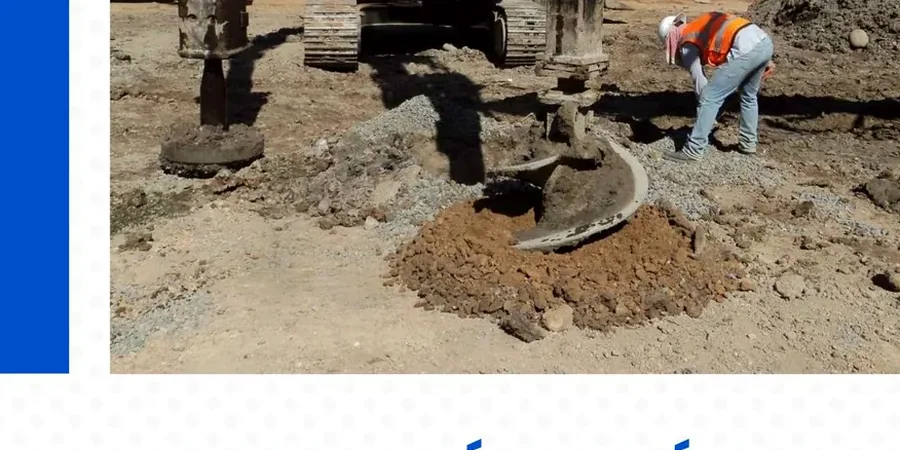
The bottom-feed vibroflot rig operating on a Dunedin harbourside site runs off a 200 kW hydraulic power pack and advances through soft silts using water flushing combined with compressed air to maintain an open hole. The operator monitors amperage draw and penetration rate in real time, because a sudden drop in resistance signals a pocket of organic peat or uncompacted hydraulic fill that needs additional stone volume to stabilise the column diameter. Noise and vibration remain the main site constraints, especially within 20 metres of heritage masonry buildings in the Exchange precinct, where peak particle velocity must stay under 5 mm/s. Another risk specific to Dunedin’s geology arises when columns penetrate interbedded sands with artesian pressure; uncontrolled water inflow can fluidise the stone column base before compaction locks the aggregate. The design must specify standby casing or a temporary casing shoe for these zones, and the construction sequence should work from the highest piezometric head toward the lower boundary to prevent cross-flow between columns. Without a site-specific installation method statement tied to the Dunedin ground model, column integrity testing with a cone penetrometer often reveals necking defects at the sand-silt interface.
Our services
Each stone column design in Dunedin follows a staged workflow that ties site investigation directly to installation parameters. The two core service packages are:
Preliminary Design and Feasibility Assessment
Review of existing CPT and borehole logs, identification of compressible layers, estimation of improvement factors using Priebe and axisymmetric finite element models, and preparation of a ground model covering the South Dunedin basin or Taieri Plain edge. Deliverables include column grid layout options, settlement reduction curves, and a preliminary cost comparison against deep foundations.
Detailed Design and Installation Specification
Production of IFC-level design drawings showing column diameter, spacing, depth to bearing stratum, aggregate gradation envelope, and load-transfer platform reinforcement. The package includes a site-specific method statement for bottom-feed or driven mandrel installation, column integrity testing protocols, and post-treatment CPT verification acceptance criteria aligned with NZGS practice.
Common questions
What soil types in Dunedin benefit most from stone columns?
Soft alluvial silts and clays below the water table, which are common across South Dunedin, St Kilda, and the reclaimed harbourside area, respond well to stone column treatment. The technique also works in loose sandy fills and silty sands where vibrocompaction alone cannot achieve the required density. Soils with undrained shear strength below 10 kPa or peat layers thicker than 500 mm typically require a load-transfer platform and closer column spacing to control bulging.
How long does a stone column design take from investigation to issued drawings?
A preliminary design based on existing CPT data can be turned around in seven to ten working days. When new site investigation is required, the full cycle including field work, laboratory classification, finite element settlement analysis, and detailed design drawings typically takes four to five weeks, depending on the complexity of the Dunedin site and the number of test panels specified.
What is the typical cost range for stone column design in Dunedin?
Design fees for a ground improvement scheme using stone columns in Dunedin generally range from NZ$2,600 to NZ$7,560, depending on the project size, number of CPT profiles requiring analysis, and whether a pre-production field trial with verification testing is included. This covers the feasibility assessment through to the IFC design package with installation specifications.
How is stone column performance verified after installation?
Verification relies on post-treatment CPT soundings placed midway between columns at a frequency of one test per 200 to 400 square metres of treated area, following NZGS recommendations. We specify cone resistance targets that correlate to the design improvement factor, and for critical structures we add plate load tests on individual columns or cross-hole seismic tomography to confirm the stiffness profile through the improved zone.