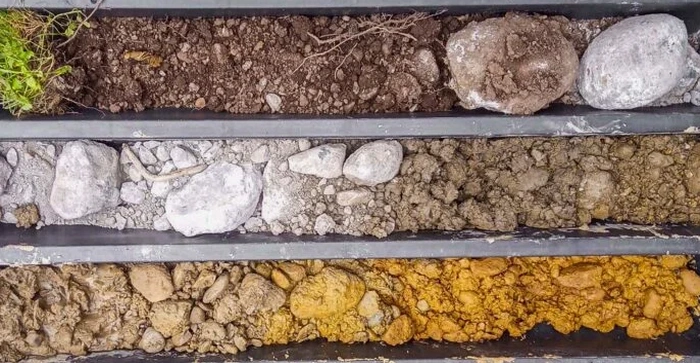
Dunedin sits on the flanks of a long-extinct volcano. The basalt flows, loess blankets, and harbour silts here change radically over just a few metres. Any contractor who has worked the hills above Kaikorai Valley or the flat near South Dunedin knows this. An exploratory test pit cuts through the guesswork. You see the strata with your own eyes. No indirect correlations. No smoothed profiles. Just the ground, exposed, logged by a geotechnical engineer on site. For anything from a hillside house extension to a commercial slab on the Taieri Plain, test pits give us the fastest, most honest snapshot of what lies beneath Dunedin’s surface. When the logs show buried topsoil or an old fill layer, the design changes immediately — and that saves money before a digger even arrives.
In Dunedin, the distance from solid basalt to saturated loess can be three metres. A test pit shows you exactly where that boundary sits.
Methodology applied in Dunedin
Local geotechnical conditions in Dunedin
The most expensive mistake we see in Dunedin is treating the whole site like one soil type. A builder digs one pit at the front corner, sees clay, and assumes it runs the full length. Then the excavator hits an old stream channel at the back — wet, soft, full of organics. The footing design collapses. That one oversight adds weeks to the programme and thousands in redesign costs. City Council consent applications for earthworks over 1.0 m depth routinely ask for physical investigation. Test pits provide the visual evidence a desk study cannot. On the Taieri, where peat lenses hide beneath firm crust, missing one pit in the low corner means differential settlement that cracks walls within the first two years. We log every pit with scale photographs, field vane readings where clays are soft, and clear descriptions a structural engineer can use directly in their calculations.
Our services
Our test pit service covers the full Dunedin area — from the basalt knolls of Pine Hill to the deep alluvium of the Taieri Plain. Each investigation is tailored to the site constraints and the information the project needs.
Machine-Excavated Test Pits
Trench or pit excavation with a local digger, logged by a senior geotechnical engineer. We expose the strata, photograph the profile, and take samples for laboratory classification. Ideal for residential foundations, retaining walls, and small commercial slabs.
Combined Pit and Borehole Investigation
Where the pit cannot reach design depth — for example on a steep Dunedin section underlain by weathered schist — we combine a 3.0 m pit with a hand-auger or machine borehole to log the full zone of influence. You get visual data at the surface and mechanical data at depth.
Pit Infiltration and Drainage Assessment
If soakage is proposed for stormwater disposal, we perform falling-head tests in the pit to measure permeability. Directly relevant for Dunedin sites outside the reticulated network where Council requires evidence of adequate soakage capacity.
Common questions
How much does an exploratory test pit cost in Dunedin?
Most residential projects in Dunedin fall between NZ$920 and NZ$1,310 for a single machine-excavated pit with engineer logging and a factual report. The total depends on depth, access for the digger, and the number of lab tests required on the samples we collect.
How deep can you excavate a test pit on my site?
Practically, we stop at 4.0 m with a standard digger. On sloped sites we may go shallower for safety. If the design needs information below 4.0 m, we switch to a borehole. The pit gives us the critical top few metres where most foundation stress dissipates.
Do I need a test pit for a simple house extension?
If your extension adds load or changes the drainage pattern, then yes. Dunedin’s loess and colluvium can soften dramatically when wet. A single pit at the proposed foundation line confirms the bearing stratum and rules out buried services or old fill that would require deeper excavation.
What information does the test pit report include?
Each report contains a site plan with pit locations, a scale log of the exposed strata with soil descriptions to NZS 4402, field test results such as hand vane shear strength, groundwater observations, and a brief engineering commentary on the implications for your foundation or retaining structure. More info.