NZS 3404 and NZGS design guidelines frame every raft foundation we engineer in Dunedin. The city rests on a complex mosaic of basalt, schist, and wind-blown loess, and that mix punishes standard footings. We see differential settlement in South Dunedin fill zones. Reactive clays in the hill suburbs. Basalt refusal at two metres in Mornington. A raft slab bridges these transitions and cuts the risk of angular distortion. The New Zealand Seismic Hazard Model assigns Dunedin a moderate-to-high hazard profile, so we size reinforcement for ductility first, not just bearing. This approach aligns with MBIE guidance and the Dunedin City Council consent process. A thorough site investigation with SPT drilling anchors the design parameters before we model the slab in bending and shear.
In Dunedin's loess-and-basalt terrain, a properly designed raft slab eliminates differential settlement risk better than isolated footings ever can.
Methodology applied in Dunedin
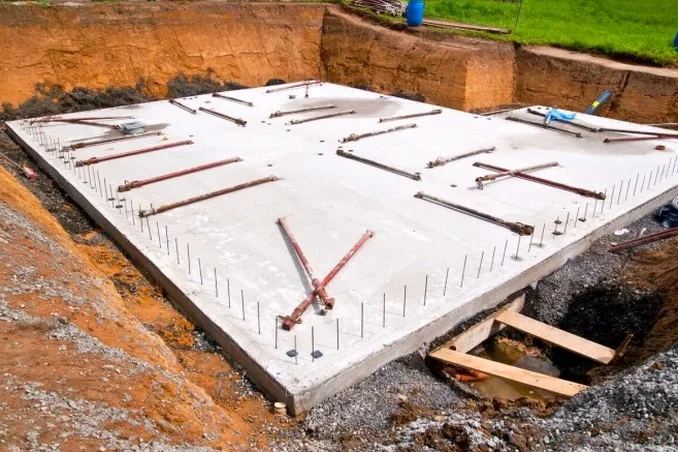
Local geotechnical conditions in Dunedin
South Dunedin sits on reclaimed harbour land with a water table less than one metre deep. That combination drives buoyancy loads and long-term consolidation settlement. A mat foundation here needs a sub-slab drainage layer and a filter fabric to stop fines migration. On the hill slopes, loess collapse upon wetting is the primary hazard; we specify moisture-conditioned subgrade and compaction to 98 percent standard Proctor before forming the slab. The Otago Peninsula presents another challenge: shallow rock with steeply dipping joints. Rafts there require dowels into competent basalt to resist sliding. Every Dunedin site gets a site-specific seismic hazard assessment because the basin-edge effect can amplify ground motion by a factor of 1.4 or more. Ignoring these local conditions leads to slab cracking within the first five years.
Our services
Structural and geotechnical engineering for raft foundations across Dunedin. Each scope includes site investigation coordination, 3D finite element modelling, and PS1/PS4 documentation.
Raft Slab Structural Design
Full bending, shear, and punching shear analysis under gravity and seismic load combinations. Reinforcement schedules and detailing for consent submission.
Subgrade Investigation & Modulus
Field derivation of the modulus of subgrade reaction using plate load tests or SPT/CPT correlation. No generic textbook values.
Seismic Demand Modelling
Site-specific response spectra per NZS 1170.5, accounting for Dunedin basin-edge effects and soil class C or D profiles.
Construction Supervision & PS4
Reinforcement inspection, concrete pour surveillance, and Producer Statement PS4 issuance for Council sign-off in Dunedin City jurisdiction.
Common questions
What does a raft foundation design cost for a Dunedin residential project?
For a standard single-family home on a loess or fill site in Dunedin, structural design and PS1 documentation typically falls between NZ$1,620 and NZ$6,940. The final figure depends on slab area, number of step-downs, and whether a site-specific seismic hazard assessment is required.
How does Dunedin's geology affect raft foundation design?
Dunedin's geology transitions from basalt cap rock to deep loess and reclaimed harbour fill within short distances. A raft foundation bridges these stiffness contrasts and reduces differential settlement. The water table in South Dunedin also demands careful drainage detailing under the slab.
What documentation do I need for Dunedin City Council consent?
A complete submission requires a Producer Statement PS1 for design, a PS4 for construction review, a site investigation report with SPT or CPT logs, and structural calculations to NZS 3404 and NZS 3101. We prepare all four documents as a single package.
Can a raft foundation perform well in a seismic event?
Yes. A raft slab acts as a rigid diaphragm that distributes lateral load uniformly to the ground. When reinforced for ductility per NZS 1170.5, a properly designed mat foundation limits angular distortion and protects the superstructure during a Dunedin earthquake.