Dunedin’s subsoil profile shifts dramatically within a few hundred metres—from the weathered schist and basalt of the peninsula to the compressible alluvial silts of South Dunedin. When foundation loads exceed what these loose granular layers can carry, a CPT test provides the continuous tip resistance and friction ratio data needed to frame a vibrocompaction programme. The city’s harbour reclamation areas, underlain by hydraulically placed sands up to 8 m thick, are particularly susceptible to settlement under seismic loading. Our design approach integrates NZGS guidelines with NZS 3404 to specify probe spacing, energy input, and verification testing that accounts for the variable water table—often within 1.5 m of the surface across the Taieri Plain. For sites where vibrocompaction alone cannot achieve the required relative density below the water table, we combine the densification grid with stone columns to provide drainage and additional stiffness through the critical upper 5 m. The goal is always a uniform Dr ≥ 70 % across the treatment zone, confirmed by post-treatment CPT soundings at the centroid of each triangular grid cell.
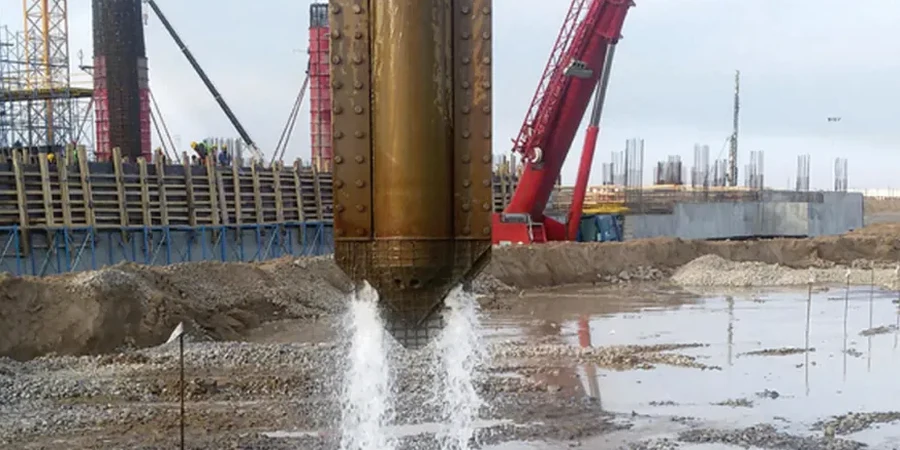
In South Dunedin’s loose harbour sands, vibrocompaction can increase relative density from 35 % to over 75 % within a single pass—verified by CPT before and after treatment.
Methodology applied in Dunedin
For sands with less than 12 % passing the 75 μm sieve, compaction radii of 1.8–2.5 m are achievable with standard V32 vibrators. Where loessial silts are present—common on the hill slopes above North East Valley—we incorporate liquefaction assessment based on the Boulanger-Idriss (2014) triggering procedure to verify that post-treatment factor of safety exceeds 1.3. Each design package includes a staged verification plan: pre-treatment CPT baseline, mid-programme check soundings after every third probe, and final grid verification before sign-off.
Local geotechnical conditions in Dunedin
Dunedin’s seismic hazard is dominated by the Akatore Fault, located roughly 30 km south-west of the city centre, with a recurrence interval of approximately 1,200–2,000 years and a characteristic magnitude around Mw 7.2–7.4. The February 2018 Otago sequence—though centred offshore and deeper than 20 km—produced felt intensities of MM IV–V in the city and reminded engineers that the region is not aseismic. Untreated loose granular soils below the groundwater table in the South Dunedin basin would be expected to undergo significant excess pore pressure generation during such an event, potentially leading to lateral spreading toward the harbour edge. A vibrocompaction design that skips site-specific CPT calibration risks under-treating zones with higher fines content, leaving pockets of liquefiable material that go undetected until post-earthquake damage surveys. We have seen this in peer reviews of older ground improvement projects where pre-treatment investigation was limited to SPT-only data. The cost of re-treatment and foundation remediation far exceeds the investment in a proper pre-design CPT campaign.
Our services
Our vibrocompaction design package for Dunedin sites includes the following deliverables, tailored to the specific ground model and structural performance requirements of each project.
Pre-treatment CPT investigation and ground model
A grid of CPTu soundings—typically at 15–25 m centres depending on site variability—to map layer boundaries, fines content, and in-situ relative density across the treatment area. Output includes a 3D ground model in Leapfrog or similar, with liquefaction susceptibility flags per NZGS Module 4.
Vibrocompaction grid design and energy specification
Probe spacing, penetration depth, vibration frequency, and hold-time parameters calculated from grain-size distribution and CPT tip resistance. Includes specification of vibrator type (electric or hydraulic), power rating, and water-jet assist where required to penetrate dense crust layers.
Post-treatment verification and compliance reporting
CPT soundings at each grid centroid, compared against pre-treatment baseline to confirm Dr ≥ 70 %. Report includes statistical analysis of improvement ratio, as-built drawings, and a producer statement (PS4) for building consent closure.
Common questions
How much does a vibrocompaction design package cost for a typical Dunedin site?
For a standard commercial or industrial site in the Dunedin area, a complete vibrocompaction design package—including pre-treatment CPT investigation, 3D ground modelling, grid design, and post-treatment verification—ranges from NZ$2,250 to NZ$9,730 depending on site area, number of CPT soundings required, and complexity of the ground profile. Smaller residential sites fall at the lower end; larger warehouse or multi-storey sites with variable stratigraphy fall at the upper end.
What soil types in Dunedin are suitable for vibrocompaction?
Vibrocompaction works best in clean sands and gravelly sands with fines content (percentage passing the 75 μm sieve) below 15 %. In Dunedin this includes the harbour reclamation sands, the alluvial sands of the Taieri Plain, and some of the wind-deposited sands on the coastal terraces. Soils with higher silt content—such as the loess-mantled slopes of the Otago Peninsula—generally require alternative ground improvement like stone columns or rigid inclusions, as the silt fraction dampens vibratory energy and inhibits effective densification.
How long does a vibrocompaction programme take on a Dunedin site?
The design phase typically requires 3–4 weeks from site investigation to issue of construction-ready drawings. The actual vibrocompaction fieldwork on site depends on grid area and probe density, but a typical 1,000 m² treatment area in Dunedin—using a single V32 vibrator rig—completes within 5–7 working days. Post-treatment verification CPT testing adds another 2–3 days, and the compliance report follows within one week of completing field work.