The geotechnical profile of Dunedin presents a unique set of challenges that standard site investigations often fail to capture. The city’s landscape, shaped by Miocene basalt flows and overlain with thick loess deposits, means that a simple unconfined compression test rarely tells the full story. When a project in the hill suburbs encounters a saturated volcanic clay, or a commercial development near the Otago Harbour requires a deep excavation, the drained and undrained shear strength parameters become non-negotiable design inputs. We see this repeatedly in the field: a soil that appears competent in a hand auger sample exhibits significant loss of strength when confined pressure is applied in the lab. This is where a rigorous triaxial test program, executed under NZS 4402 and D2850 standards, moves the project from geotechnical assumption to quantified certainty. Unlike index tests that only classify the material, a properly staged triaxial test defines the Mohr-Coulomb failure envelope that a structural engineer needs to model bearing capacity at depth, especially when footings are to be embedded in the Port Chalmers breccia or the variable colluvium of the Town Belt.
A consolidated undrained triaxial test with pore pressure measurement reveals the true effective stress strength of a saturated loess, a parameter that a simple vane shear test in the field will grossly misrepresent.
Methodology applied in Dunedin
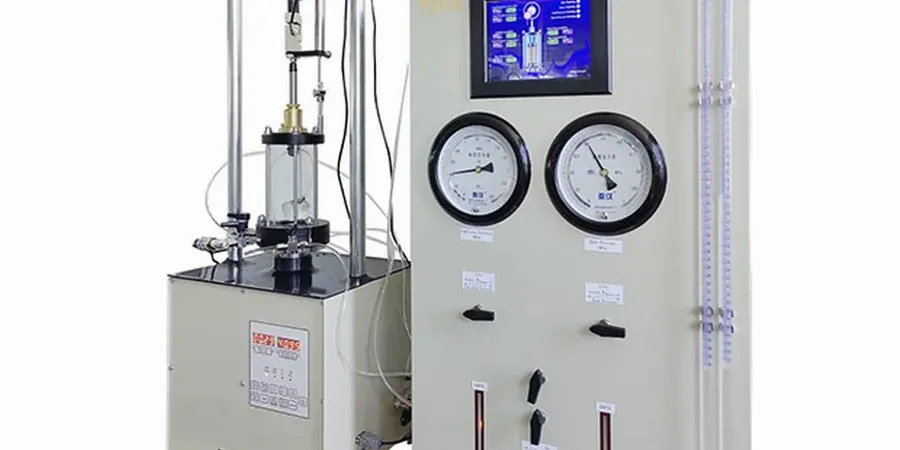
Local geotechnical conditions in Dunedin
The coastal climate of Dunedin, with its persistent rainfall and high groundwater table across the Taieri Plain and South Dunedin basin, creates a soil environment that is rarely in a dry, drained state. This means that for any cut deeper than 2 metres, the undrained shear strength (su) becomes the governing parameter for short-term stability. A triaxial test that is not back-pressure saturated to in-situ stress conditions will produce a falsely high strength envelope, because the specimen remains partially saturated and exhibits matric suction that does not exist in the field. We have reviewed projects where a designer used UU triaxial data from unsaturated specimens to justify a steep temporary batter in a silty clay, only to encounter slumping after a single heavy rain event. The risk compounds when the project involves a sensitive landform, such as the loess-mantled slopes above the harbour or the reclaimed land beneath the warehouse district, where the soil structure is metastable. In these materials, the peak strength measured in the triaxial cell may drop to a much lower residual value after just a few percent strain, a behaviour that only a well-instrumented test with post-peak data logging can capture.
Our services
Our triaxial testing programme in Dunedin is designed to deliver the specific engineering parameters required for each project phase, from preliminary feasibility to detailed foundation design. We work with a network of local drilling contractors to ensure samples are transported in accordance with Category A and B sampling standards, preserving the in-situ fabric and moisture content of the sensitive soils found across the city.
CU Triaxial Suite with Pore Pressure Measurement
A three-specimen consolidated undrained programme that defines the effective stress strength envelope (c' and φ') for drained long-term analysis, while simultaneously providing the undrained shear strength profile for short-term construction conditions. Essential for modelling the behaviour of the Dunedin loess and harbour sediments under both static and seismic loading.
Multi-Stage UU Triaxial for Stiff Overconsolidated Tills
For the dense, gravelly tills encountered in the hill suburbs and on the Otago Peninsula, a multi-stage unconsolidated undrained test on a single specimen minimises the scatter caused by natural heterogeneity. This approach delivers a reliable undrained shear strength profile for pile shaft friction calculations and temporary works design, where a rapid, solid parameter is needed.
Common questions
What is the difference between a UU and a CU triaxial test, and which one do I need for my Dunedin project?
An Unconsolidated Undrained (UU) test provides a total stress undrained shear strength (su) without measuring pore pressure, and it’s typically used for short-term stability on low-permeability soils where loading is rapid. A Consolidated Undrained (CU) test with pore pressure measurement yields both undrained shear strength and effective stress parameters (c' and φ'). For most Dunedin projects involving cuts in saturated loess or harbour muds, the CU test is the correct choice because it separates the soil’s frictional strength from the excess pore pressure that builds up during loading—a distinction that directly controls the factor of safety in a slope stability or retaining wall design.
How long does a triaxial test programme typically take from sample receipt to final report?
A standard CU triaxial programme with three effective consolidation stresses requires approximately 7 to 10 working days from the start of testing. The duration is governed by the consolidation phase, which for a 50 mm diameter specimen of silty clay can take 24 to 48 hours per stress stage to achieve full primary consolidation, plus an additional 24 hours for the shearing stage run at a slow, drained rate. For time-sensitive projects, we can run multiple triaxial cells in parallel to accelerate the programme.
What is the typical cost range for a triaxial testing programme in Dunedin?
A comprehensive triaxial testing programme in Dunedin, including a suite of three CU tests with pore pressure measurement and a detailed interpretation report with Mohr-Coulomb parameters, typically ranges from NZ$2,980 to NZ$5,230. The exact cost depends on the number of specimens, the required consolidation stress range, and whether the samples require special preparation due to their sensitivity or fabric.
Can a triaxial test be performed on remoulded samples if undisturbed samples are not available?
Yes, we routinely test remoulded specimens when the objective is to determine the strength of a compacted fill or to characterise the residual strength of a material. The specimen is compacted to a specified dry density and moisture content, then saturated and sheared under the required drainage conditions. However, it is important to understand that a remoulded specimen will not replicate the natural fabric and cementation of an undisturbed sample from a Dunedin loess deposit, so the results should be used with appropriate engineering judgement in the context of the design scenario.