The first thing most people notice on a Dunedin excavation site is the ground itself. Basalt columns and weathered schist don't give way easily, and that means your equipment choices matter from day one. In our experience across the city, from steep hillside cuts near Roslyn to the deeper commercial basements in the CBD, the difference between a smooth dig and a costly delay often comes down to how well the temporary support system matches the actual rock mass conditions. We work with local contractors to stage excavation sequences that respect the joint patterns and groundwater behaviour unique to this volcanic landscape. Before breaking ground on any Dunedin project, we also recommend integrated site investigation with SPT drilling to calibrate strength parameters against the weathered profiles we know dominate the upper 15 metres across much of the city.
In Dunedin's fractured basalt, a well-designed excavation sequence is worth more than a heavier shoring system.
Methodology applied in Dunedin
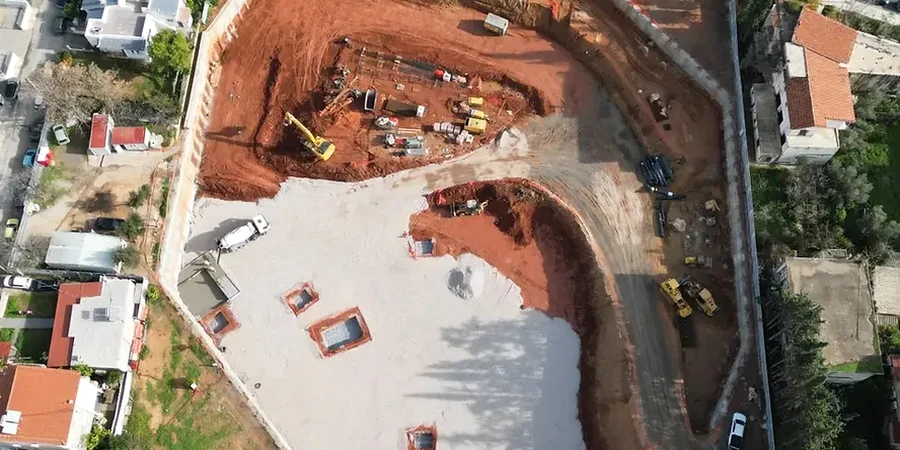
Local geotechnical conditions in Dunedin
What we keep seeing in Dunedin is groundwater surprises. A dry-looking basalt face can suddenly deliver 2 litres per second through an open joint once the excavation reaches full depth, and that's when things get expensive if the dewatering plan wasn't sized for it. The layered geology also creates a real risk of wedge failure where the cut slope exposes a contact between massive basalt and the underlying weathered schist: the weak interface can daylight right at the worst moment. On the flat land, particularly in South Dunedin's reclaimed areas, the risk shifts to basal instability in soft, compressible soils where the excavation depth exceeds the crust thickness. We address these scenarios through observational method protocols, where the design includes contingency measures pre-approved before the excavator bucket ever touches the ground.
Our services
Our Dunedin excavation design work covers the full project lifecycle, from feasibility-level advice on shoring options through to detailed construction documentation and observation during the dig.
Temporary shoring design
Soldier pile and lagging, secant piles, or soil nail walls configured for Dunedin's basalt and schist ground conditions.
Dewatering and groundwater control
Design of deep well systems, sump pumping arrays, and cutoff walls to manage perched water in fractured volcanic rock.
Construction stage stability analysis
Finite element and limit equilibrium analysis of each excavation step, with basal heave checks for soft South Dunedin alluvium.
Monitoring specification and review
Inclinometer arrays, vibration limits, and settlement points with trigger values, reviewed weekly during active excavation.
Common questions
What ground conditions in Dunedin most affect deep excavation design?
The dual challenge is fractured basalt with open joints that transmit groundwater unpredictably, and the weathered schist beneath it that loses strength rapidly when exposed. In the flat areas, compressible estuarine clays and silts under South Dunedin and the harbourside require careful basal heave assessment. Our designs always start with a detailed geological model specific to the site's volcanic and metamorphic context.
What does geotechnical design for a deep excavation typically cost in Dunedin?
For a full design package covering shoring, dewatering, staged stability analysis, and monitoring specifications, fees generally range from NZ$3,760 to NZ$14,060 depending on excavation depth, geological complexity, and whether seismic liquefaction assessment is required. Simple residential cuts fall at the lower end; multi-level commercial basements in variable rock reach the upper range.
How long does the design process take before construction can start?
For a typical Dunedin project, allow three to five weeks from site investigation completion to issued-for-construction drawings. This includes geological model development, numerical modelling of staged excavation, peer review, and coordination with the structural engineer. Projects requiring resource consent input may extend the timeline by two to three weeks.