Dunedin's undulating terrain, carved from ancient basalt and mantled with windblown loess, presents a specific set of challenges for anyone compacting fill. The loessial clays that drape the hillsides around the city are highly sensitive to moisture change, and getting the water content wrong during compaction is the quickest way to generate settlement later. The Proctor test, under NZS 4402:1986, quantifies that relationship between moisture and achievable density. The laboratory team sees a wide range of materials from across the city, from the weathered schist of the Town Belt to the volcanic tuffs near Port Chalmers. When specifications demand a documented maximum dry density, the test provides the reference value that all field density checks are measured against. For pavement subgrades on the arterial routes out toward Mosgiel, the CBR test often relies directly on Proctor results to determine soaked strength at a target compaction level, linking laboratory understanding to long-term road performance.
The peak of the Proctor curve is not just a number; it is the compaction target that ties field rolling to a measurable, repeatable laboratory reference for Dunedin's variable loessial and volcanic soils.
Methodology applied in Dunedin
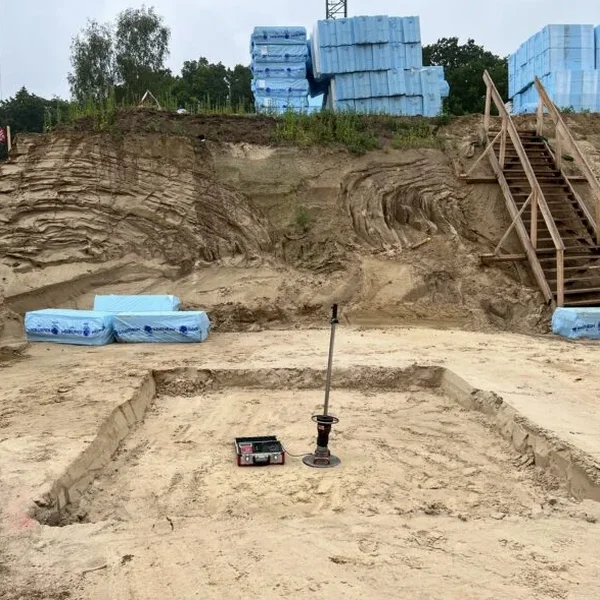
Local geotechnical conditions in Dunedin
A contractor on a commercial building site in South Dunedin once placed structural fill over a soft reclaimed layer, relying on a generic density specification without understanding the actual Proctor reference for the imported material. Nuclear gauge readings looked acceptable in the field, but the fill was several percent wet of optimum, leaving a spongy subgrade that required costly rework before the slab could be poured. The lesson is straightforward: without a project-specific Proctor and careful moisture control during placement, the risk of post-construction settlement rises sharply. In Dunedin's loessial terrain, this is amplified by the soil's tendency to collapse structurally when wetted under load. The laboratory compaction curve defines the exact dry density that the material can achieve under controlled energy, and any field density test that reports 95% of an assumed maximum without it being verified is effectively a guess. For deep fill projects on the steeper sections of the peninsula, the Modified Proctor becomes the governing standard precisely because the consequences of under-compaction are more severe on sloping ground where differential settlement can initiate a creep failure.
Our services
Compaction control is a system, and the Proctor test is the laboratory benchmark around which the rest of the system is built. The following services support earthworks compliance from the laboratory bench to the field in Dunedin and across the Otago region.
Standard Proctor Test (NZS 4402 Test 4.1)
Determines the maximum dry density and optimum moisture content for soils using light compactive effort. Suitable for residential fill, landscaping, and trench backfill where traffic loading is minimal.
Modified Proctor Test (NZS 4402 Test 4.2)
Applies heavy compactive effort to simulate modern vibratory rollers. Specified for highway embankments, commercial building pads, and any structural fill on the Dunedin Northern Motorway corridor and arterial road projects.
Moisture-Density Relationship Analysis
Full interpretive report of the compaction curve including zero-air-voids line, identification of material sensitivity to moisture, and recommendations for field compaction target ranges considering Dunedin's variable loessial and volcanic parent materials.
Common questions
What does a Proctor compaction test cost for a Dunedin project?
For a single-point or three-point Proctor test on a typical Dunedin loess sample, the laboratory fee ranges from NZ$180 to NZ$300, depending on whether the standard or modified effort is specified and whether the material requires special preparation like drying or oversize correction.
Which Proctor method, standard or modified, is right for my earthworks?
It depends entirely on the compaction plant on site and the specification. The modified Proctor (Test 4.2) is required for most structural fill and roading projects in New Zealand because it better represents the energy of a heavy vibratory roller. The standard Proctor (Test 4.1) is still used for some landscaping fills, farm dams, and trench backfill where lighter compaction equipment is specified. The engineer of record for the earthworks will define the reference test in the technical specification.
How much soil sample is needed for a Proctor test?
A minimum of about 25 kg of representative material is required for a standard three-point Proctor curve. If the soil contains gravel larger than the test method permits, additional mass may be needed to allow for particle replacement or to run a separate oversize correction. The laboratory can advise on sampling requirements once the gradation and geology of the fill source are known.